
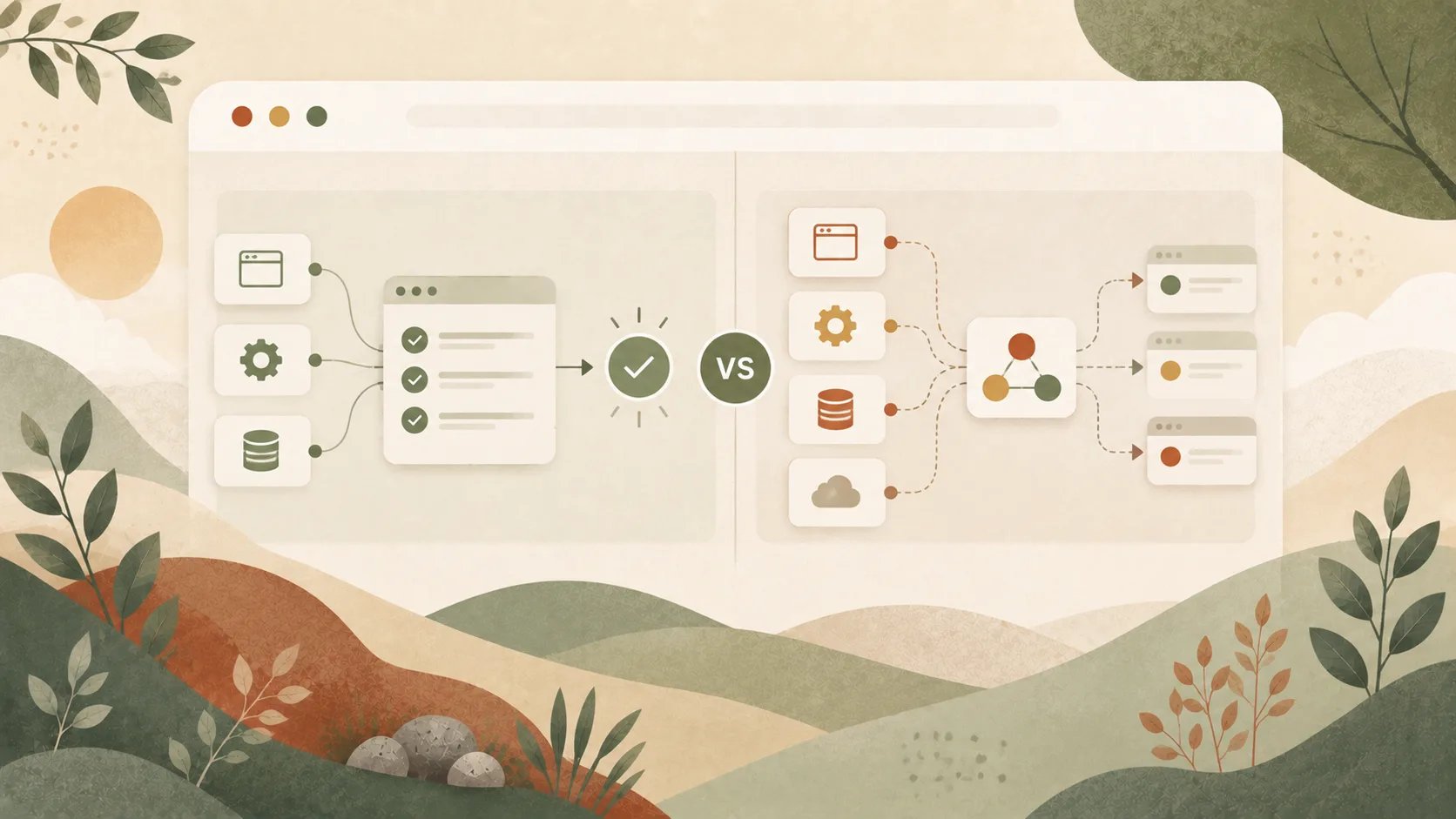
Currents (currents.dev) helps your existing CI infrastructure run Playwright tests faster. Endform is a Playwright test runner with no shard limit: every test runs on its own machine, so increasing test coverage doesn’t increase wait time.
Who owns your CI infrastructure?
Currents is a Playwright-focused reporter, dashboard, and orchestrator. It replaces Playwright’s static --shard command with a dynamic queue, matching spec files to whichever CI runner is available instead of splitting them by file order. Currents cites gains of up to 40 percent over native sharding.
That orchestration still runs on CI machines you provision and pay for, whether that’s GitHub Actions, CircleCI, or another provider. You still choose runner types and concurrency limits, and GitHub Actions caps concurrent jobs on GitHub-hosted runners at 20 on Free plans and up to 500 on Enterprise, with a hard limit of 256 jobs per workflow matrix.
Endform takes a different approach. Browser tests are often constrained by available CPU and memory, and running many tests on the same machine creates contention. Endform gives each test an isolated machine and runs them simultaneously, making suite duration a function of the slowest test. There is no CI matrix to manage, and reporting and analytics come at no extra cost.
Where each tool wins
The difference between these two tools comes down to execution, infrastructure ownership, pricing, and the kinds of teams they were built for.
| Capability | Endform | Currents |
|---|---|---|
| Execution model | Provisions one isolated machine per test | Orchestrates tests across CI machines you provision |
| Infrastructure ownership | Endform owns and scales execution infrastructure | You own, configure, and pay for CI compute (GitHub Actions, CircleCI, etc.) |
| Framework compatibility | Playwright-native CLI replacement | Reporter and orchestrator layer for Playwright and Cypress, with reporting for Jest and Vitest |
| Suite runtime | Your single slowest test | Depends on CI machine count and orchestration, capped by your CI budget |
| Sharding required | No | Reduces manual shard tuning, but CI worker provisioning is still required |
| Setup | One CLI command with no configuration changes | Reporter and orchestration configuration added to an existing CI pipeline |
| Reporting & analytics | Flaky test detection, quarantine, historical trends, and stored traces | Strong dashboard, real-time streaming, and detailed analytics |
| Pricing model | Execution: usage-based, $0.01/test minute, no tiers. Reporting: free | Execution: customer-provided CI machines. Reporting and orchestration: tiered plans based on monthly test results |
| Free usage | 2,000 free test minutes, no credit card required | Free trial, no free plan |
| Best fit | Teams that want CI time to scale independently of test count | Teams committed to existing CI infrastructure or required to run tests in-house for regulatory or compliance reasons |
Currents bundles orchestration and reporting into plans priced by monthly test results, and you pay for CI compute on top. With Endform, you pay per test minute for execution, and reporting is free.
Why teams choose Endform
- Suite runtime is bounded by your slowest test. Endform runs every test on its own machine at the same time.
- No test infrastructure to manage. No worker provisioning, no spot instances, and no shard configuration. Endform manages the compute layer.
- More coverage without longer waits. Teams often limit E2E coverage because of execution cost. Lovable increased its test coverage 10× while reducing runtime by 80%, adding tests it had deferred as “too expensive”.
- One command to switch. Replace the CLI and keep your existing Playwright configuration unchanged.
When Currents is the right choice
- You want to keep your existing CI infrastructure. Better scheduling and reporting can improve how your current pipeline is used.
- You run Cypress alongside Playwright. You can manage both from one dashboard.
- Your suite fits within your current CI capacity. Visibility into test runs and flaky test tracking matter more to you than changing the execution model.
- You rely on CI event automation. Native Jira issue creation, Slack integrations, and webhooks can trigger from test results.
How to migrate to Endform
Switching to Endform requires a CLI swap:
npx endform testYour existing playwright.config.ts files, projects, and reporters carry over unchanged. Currents-specific setup (currents.config.ts, pwc-p commands) and Playwright --shard flags are no longer needed because Endform runs without a CI matrix. The config reference documents the settings available in endform.config.ts.
Which fits your team
The right choice comes down to where the constraints are. If CI machine capacity or cost increases as your suite grows, Endform runs each test on its own machine so execution is no longer tied to CI concurrency limits. If your current setup already handles execution well and your priority is better visibility into failures and flaky tests, Currents is a strong option.
More comparisons: Endform vs. Checkly
Get started
Endform is the fastest way to run your Playwright suite in CI. Swap one command, keep every test as it is, and get a pass or fail on every pull request in the time of your slowest test.
Prefer to look before you commit? Talk to us or read the docs.
FAQ
What is the difference between Endform and Currents?
Endform runs your whole Playwright suite in its cloud, with every test on its own machine, so the suite finishes in the time of your slowest test. Currents (currents.dev) is a reporter, dashboard, and orchestrator that schedules your tests across CI machines you provision and pay for.
Is Endform an alternative to Currents?
Yes, for Playwright suites. Endform replaces both the orchestration layer and the CI machines your tests run on: every test gets its own machine, and flaky test detection, analytics, and stored traces come at no extra cost. Your existing Playwright config and tests carry over unchanged.
Is Currents a Playwright test runner?
No. Currents is a reporter, dashboard, and orchestrator built on Playwright’s test runner. It schedules tests across CI machines and reports the results, while Playwright handles execution.
Does Currents replace the need for CI machines?
No. Tests still run on your CI machines, so you continue to pay for the compute used during test execution. Currents handles test scheduling across those machines, while the CI infrastructure remains in place.
Can I migrate from Currents to Endform without rewriting my tests?
Yes. Endform uses the same playwright.config.ts, so your test files can remain unchanged. Currents-specific configuration, including currents.config.ts and orchestration commands, can be removed during the migration. The config reference covers the Endform setup.
Does Endform offer the same flaky test detection and analytics as Currents?
Endform includes flaky test detection, quarantine, historical trends, and stored traces at no extra cost, with no separate analytics subscription required. Currents offers real-time streaming and a more extensive dashboard alongside its orchestration features, which may appeal to teams that place a higher priority on reporting and test visibility.
Is Endform more expensive than Currents?
Compare the total cost, not just the plans. Endform’s $0.01-per-minute rate covers execution and reporting, so a run of 500 tests averaging 30 seconds each costs about $2.50. On Currents, the same run uses 500 of the 10,000 monthly test results in the $49 Scale plan (as of October 2026), and your CI provider bills separately for the machines that run it.