
Endform runs your Playwright suite fast in CI, Checkly monitors production with scheduled synthetic checks. This page helps you work out which one you actually need.
Testing vs. monitoring
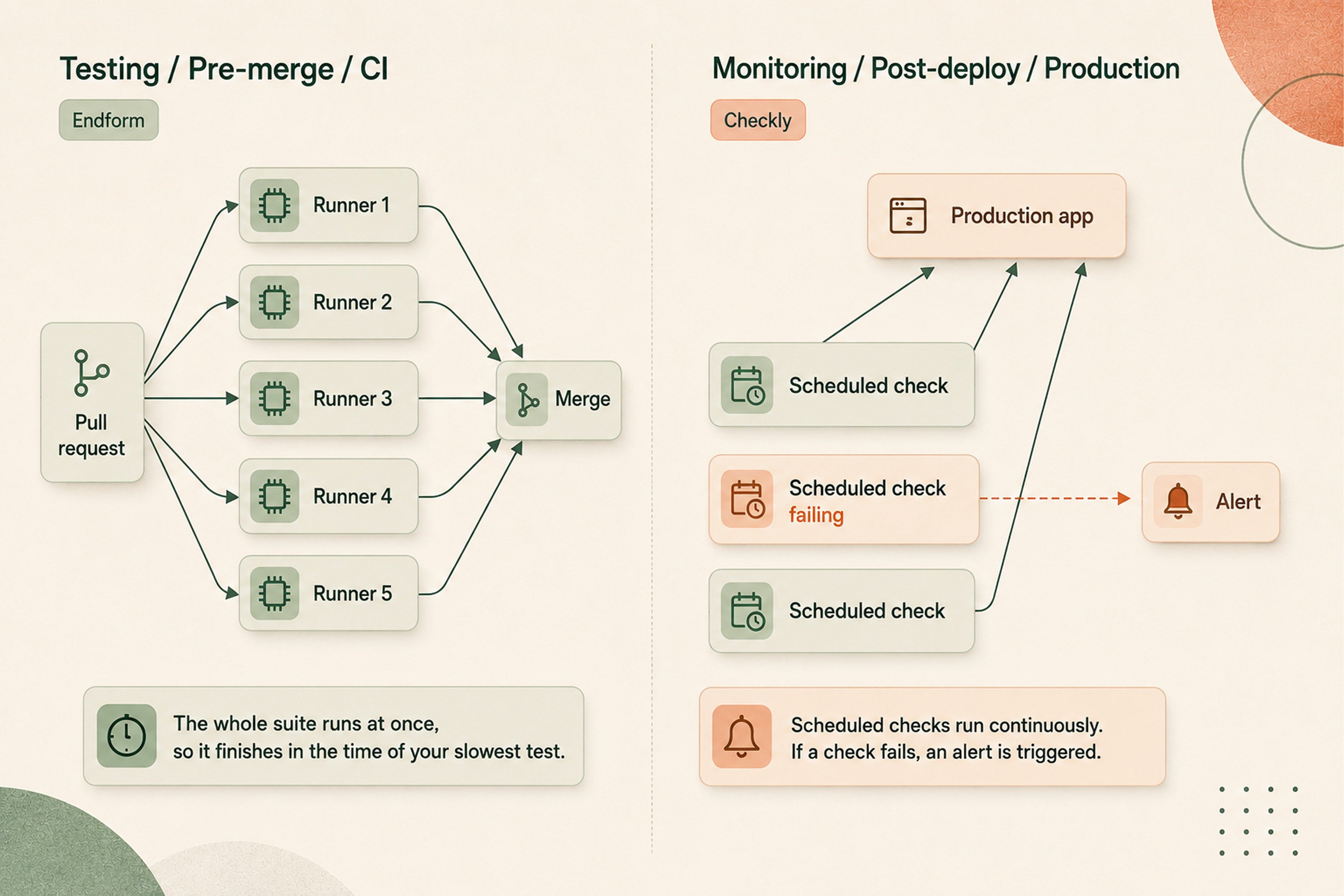
Teams weigh Endform against Checkly, yet the two tools solve different problems. Endform is a Playwright test runner built for speed. It runs your existing suite in parallel across hundreds of browsers and returns results in seconds, with most suites finishing in under two minutes, whether that’s a handful of tests or the hundreds of thousands some teams run every week.
Checkly is a synthetic monitor. It runs a set of critical checks against production on a schedule, from locations around the world, and alerts your team the moment something breaks.
Endform’s job is to run your whole Playwright suite on every pull request without changing your tests or config, and get it done fast. Checkly’s job is watching production once it’s live. Different work, and many teams run both.
Where each tool wins
Both support Playwright, so the difference that matters is what each tool is built to do. Here’s where each fits.
| Endform | Checkly | |
|---|---|---|
| Category | Playwright test runner | Synthetic monitoring |
| Primary purpose | Run your existing Playwright suite with every test on its own isolated machine, fully in parallel, so results come back fast | Monitor production with scheduled checks and alert your team when something breaks |
| Playwright compatibility | Full and drop-in: global setup, projects, and custom dependencies all run unchanged | Runs Playwright for monitoring checks, but only a subset of Playwright’s config options. No projects, global setup, parallelism, or sharding, and it won’t read your existing playwright.config |
| Setup effort for a CI suite | Swap one CLI command, no test or config changes | Write checks as monitors, then set schedules, locations, and alert rules |
| Pricing model | Usage-based at $0.01 per test minute, no tiers, no monthly minimums, no per-seat fees | Tiered plans with per-check-run billing, where browser and Playwright runs are metered and overages apply above your plan’s allowance |
| Best for | Teams with large or fast-growing Playwright suites that need to run fast and fully parallel, without having to rewrite | Teams that need production uptime monitoring, global synthetic checks, and incident alerting |
Why teams choose Endform for Playwright in CI
Endform takes your existing Playwright suite and returns a pass or fail on every pull request. What you get:
- Drop-in, with zero config: The only change is one CLI command. No test or config changes, and global setup, projects, and custom dependencies keep working, because Endform is fully Playwright compatible.
- Full parallelization: Every test runs on its own machine, so the suite finishes in the time of your slowest test, whether you have 10 or 1,000. Because retries also run in parallel, the whole suite still finishes in under twice that time, no matter how many retries you set.
- Speed: Suites that used to run for tens of minutes finish in under two, more than 20x faster.
- Usage-based pricing: $0.01 per test minute. No tiers, no monthly minimums, no per-seat fees. You pay for what you run, so trimming slow tests cuts your bill directly.
- Historical analytics: Track failures, flaky tests, and performance trends across every run.
- Flaky test detection: Endform spots flaky tests and recurring failures from your test history, before they cost you a re-run.
- Test against local servers: Endform routes traffic from its runners back to a server on your CI machine or dev environment. You don’t need to deploy it or open it to the internet first.
Lovable’s suite grew 10x while runtime dropped over 80 percent, and they now run three million Playwright tests a week on Endform. Here’s how Lovable 10x’d their Playwright test suite while speeding up CI.
When Checkly is the right choice
Endform runs your tests in CI. By design, it doesn’t monitor production. Checkly is built for production monitoring.
Checkly runs scheduled synthetic checks against your live app from locations around the world, watches uptime and availability, and pages your team through Slack, PagerDuty, or SMS when a critical path breaks.
That’s a separate job from running your suite in CI, which is why plenty of teams use both: Endform in CI to stop bad changes merging, and Checkly on production to catch what only shows up once real users are on it. Checkly’s own guidance says the same: keep deep test coverage in CI, and use monitoring for uptime coverage in production.
The switcher story: Matsmart
Matsmart, a Nordic e-commerce company, ran their Playwright tests on Checkly before moving to Endform. That setup worked well enough until their suite started growing.
The clearest one was parallelization. Matsmart couldn’t tune concurrency to match their backend’s capacity, so scaling up test runs risked overwhelming their own services. Billing pushed the wrong way too. Paying per test run meant shaping the suite around what was cheap to run rather than what made sense as tests, and they had little visibility into where that spend was going.
The move to Endform closed those gaps. Their existing Playwright suite ran as-is, with no rewrites, and they could dial parallel execution up or down to protect backend services during a run. Time-based pricing lets them structure the suite for clarity instead of around cost, with usage they could track.
With Endform, we finally get to focus on expanding our E2E test suite, instead of fighting the test runner. Endform is predictable, reliable and fast.
— Alvar Lagerlöf, Senior Frontend Developer at Matsmart
Which should you choose?
If you’re still deciding, the decision comes down to the job you’re trying to do.
Choose Endform if your Playwright suite is slowing you down as it grows. You get full parallelization with every test on its own machine, so the suite finishes in the time of your slowest test whether you have ten or a thousand. It’s drop-in with no changes to your existing tests or config, and a leaner suite costs less to run.
Choose Checkly if you need to monitor production uptime and availability. It runs scheduled synthetic checks from locations around the world, pages your team when something breaks, and gives you status pages to keep everyone informed during an incident.
Since both tools cover different stages of the testing process, many teams end up using both: Endform catches bad changes before they merge, and Checkly catches problems after they ship.
Ready to speed up your CI suite? Start free with Endform.
Get started
Endform is the fastest way to run your Playwright suite in CI. Swap one command, keep every test as it is, and get a pass or fail on every pull request in the time of your slowest test.
Start free
2,000 free test minutes, no credit card required.
Prefer to look before you commit? Talk to us or read the docs.
FAQs
What is the difference between Endform and Checkly?
Endform runs your full Playwright suite in CI and returns a pass or fail on every pull request. Checkly runs checks against production on a schedule and alerts you when something breaks. Different jobs, and many teams run both.
Does Checkly support full Playwright test suites, or only monitoring scripts?
Full suites, not just single scripts. Checkly is built on Playwright and can run a whole suite as scheduled monitors. The difference from Endform is purpose, not capability: Checkly runs them on a schedule against production, Endform runs your suite fast in CI on every PR.
Why did teams switch from Checkly to Endform?
As a suite grows, a monitoring tool is the wrong shape for it. Matsmart couldn't tune concurrency to match their backend, and per-run billing pushed them to optimize for cost over structure. On Endform the full suite runs in parallel on every PR, and pricing doesn't punish a bigger suite.
Can I use my existing Playwright tests with Endform without rewriting them?
Yes. Swap one CLI command, with no test or config changes. Endform stays fully Playwright compatible, including global setup, projects, and custom dependencies.
What happens to test history and flakiness data when I move from Checkly to Endform?
Your Checkly history stays in Checkly, and Endform starts building its own from your first run. Its analytics then track failures, flag flaky tests, and show performance trends over time.